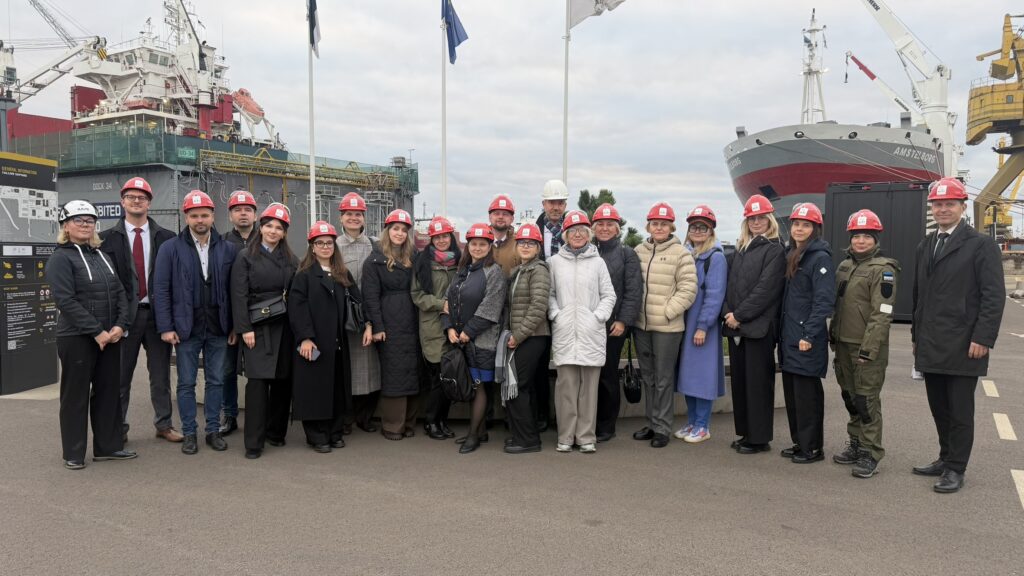
From 10 to 18 October, representatives of Ukrainian public authorities visited Finland and Estonia to learn about European experience in implementing integrated environmental permits for small and medium-sized industrial installations.
The study visit brought together representatives of the Ministry of Economy and Environment of Ukraine, the State Agency on Energy Efficiency and Energy Saving of Ukraine, the State Agency of Water Resources of Ukraine, and the State Environmental Inspectorate of Ukraine.
What are unified environmental permits, and how do they benefit businesses?
Industrial facilities must comply with a range of environmental requirements, including monitoring air emissions, managing wastewater and waste, and assessing the environmental impact of their operations. Meeting these requirements involves obtaining the relevant permits, preparing documentation and following established procedures.
Unified environmental permits bring together requirements covering different aspects of an industrial installation’s environmental impact within a single permitting framework for small and medium-sized enterprises.
This approach reduces the number of administrative procedures and establishes clear requirements for businesses. For example, a facility that affects air quality may find it easier to comply with a single permit that consolidates the relevant requirements than to navigate several separate permitting procedures.
Clearly defined requirements also help businesses plan their production processes, understand their obligations and anticipate the costs of environmental protection measures. For public authorities, such a system provides a basis for consistent oversight of environmental compliance.
Finland’s experience
In Finland, the Ukrainian delegation met with representatives of the Finnish Ministry of the Environment and the Finnish supervisory authority. The participants explored how environmental governance is organised, how the permitting system operates, and how public oversight, procedural transparency and public participation are ensured.
Meetings with specialists from the City of Helsinki focused on the digitalisation of permitting procedures and practical experience in regulating livestock farming operations in light of the updated requirements of the Industrial Emissions Directive (IED 2.0).
The programme also included technical visits to industrial facilities, where the participants learned how environmental requirements are applied in practice:
- The delegation explored approaches to measuring stack emissions, flue gas treatment systems, technologies for reducing emissions, high-temperature incineration and plastic recycling during their visit to NG Nordic company.
- At Teknos, the participants learned about practices for regulating and monitoring volatile organic compound (VOC) emissions at a paints and coatings manufacturing facility.
- During a visit to Helen company and its combined heat and power (CHP) plant, the delegation examined the environmental aspects of energy production, the use of natural gas and biomass, emissions treatment and monitoring systems, and the specific features of environmental permitting in the energy sector.
These examples provided an opportunity to examine how environmental requirements are applied across different industries and how businesses implement technical solutions to monitor and control their environmental impact.
Estonia’s experience
In Estonia, the Ukrainian delegation explored how requirements related to air quality, water resources, waste management and mineral resource consumption can be consolidated into a unified environmental permit.
Particular attention was paid to KOTKAS, a digital system used by applicants to interact with environmental authorities. It enables users to submit documents, manage permits, report on environmental impacts and provide the required data for monitoring. Such tools make it easier for businesses to track permitting procedures and comply with established requirements, while helping public authorities process information and carry out oversight.
The participants saw how these requirements are applied in industrial operations during a visit to the BLRT industrial group. They learned about the organisation of emissions monitoring and the company’s practical experience of working with environmental authorities.
How can this experience benefit Ukraine?
The aim is to bring Ukraine’s environmental regulatory framework closer to EU standards and legislation, create conditions for responsible business practices and ensure effective environmental protection.
The experience of Finland and Estonia will help identify practices that could be applied to improve Ukraine’s environmental permitting system. This, in turn, can help businesses comply with environmental requirements and enable public authorities to monitor and regulate the environmental impact of industrial activities more effectively.
The study visit was organised jointly by the projects “Best Available Techniques (BAT) for Ukraine” and “Supporting Ukraine in the implementation of the Paris Agreement in Ukraine (PAABS),” implemented by Deutsche Gesellschaft für Internationale Zusammenarbeit (GIZ) GmbH on behalf of the German Federal Ministry for the Environment, Climate Action, Nature Conservation and Nuclear Safety (BMUKN) under the framework of the International Climate Initiative (IKI).