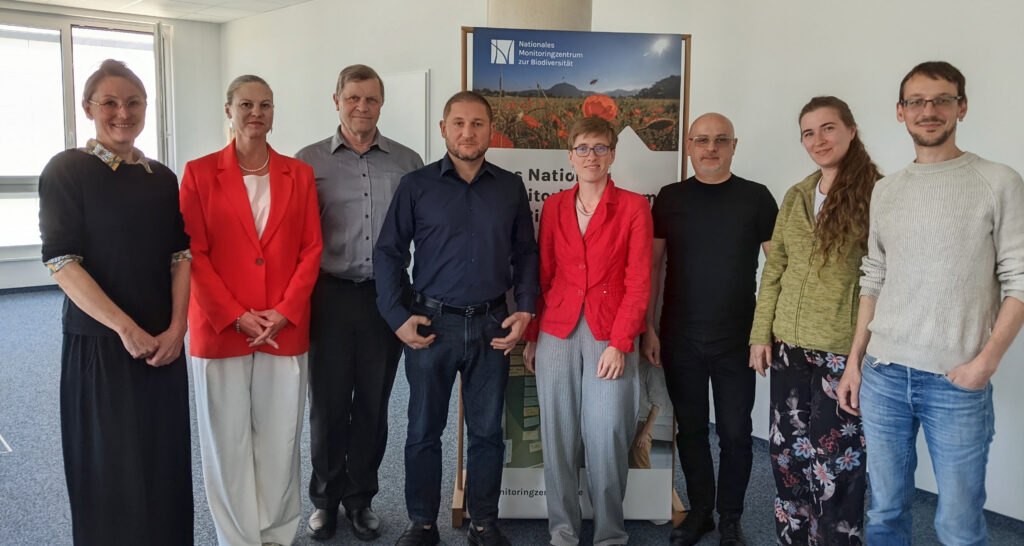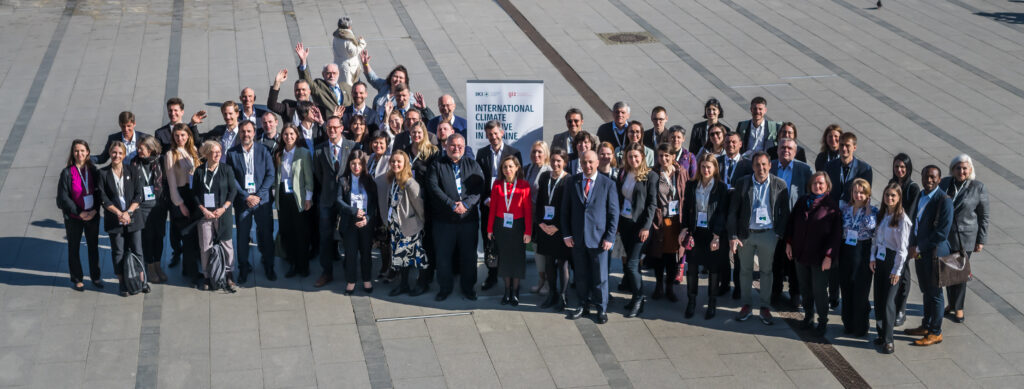
On 30 April 2026, a Ukrainian delegation visited the National Biodiversity Monitoring Centre in Germany in Leipzig. The delegation included representatives from the Ministry of Economy, Environment and Agriculture of Ukraine, the IKI Interface Ukraine project, implemented by the Deutsche Gesellschaft für Internationale Zusammenarbeit (GIZ), and Ukrainian Nature Conservation Group .
In Ukraine, biodiversity monitoring is on a way of improvement and is going to be centrally organised and guided by international and European frameworks. The country is a Party to the Convention on Biological Diversity and is committed to implementing the Kunming-Montreal Global Biodiversity Framework. The development of a National Biodiversity Strategy and Action Plan is seen as a key element of Ukraine’s reconstruction agenda and its path towards sustainable development.
Despite the significant challenges caused by the ongoing war, Ukraine continues to advance the establishment of a modern biodiversity monitoring system. International support, including through projects under the German Federal Ministry for the Environment, Nature Conservation, Nuclear Safety and Consumer Protection (BMUKN) in the framework of the International Climate Initiative (IKI), contributes to strengthening institutional capacities.
Planned developments include the establishment of a national monitoring centre and a centralised digital platform for biodiversity data collection and analysis. In this context, the experience of Germany’s National Biodiversity Monitoring Centre, established in 2021, provides valuable reference points.
A central focus of the exchange was the structure and mandate of the German monitoring centre and its contribution to national biodiversity assessment. Participants discussed how biodiversity monitoring is coordinated in Germany and which approaches are being used to further develop and strengthen the system. In addition, experts from the Federal Agency for Nature Conservation presented examples of two nationwide standardised monitoring programmes and shared selected results.
The Ukrainian delegation showed particular interest in Germany’s federal coordination mechanisms, action planning processes, and the participatory development of an integrated national monitoring concept. Both sides underlined the importance of reliable, high-quality data as a foundation for effective biodiversity conservation. At the same time, it was acknowledged that closing existing biodiversity knowledge gaps remains a complex task that requires a broad range of methodological approaches.
The visit was organized by the project “IKI Interface: Supporting Ukraine towards Ambitious and Integrated Climate Policy (Green Ukraine)”, implemented by Deutsche Gesellschaft für Internationale Zusammenarbeit (GIZ) GmbH on behalf of the German Federal Ministry for the Environment, Nature Conservation, Nuclear Safety and Consumer Protection (BMUKN) under the International Climate Initiative (IKI), in cooperation with the Ministry of Economy, Environment and Agriculture of Ukraine.