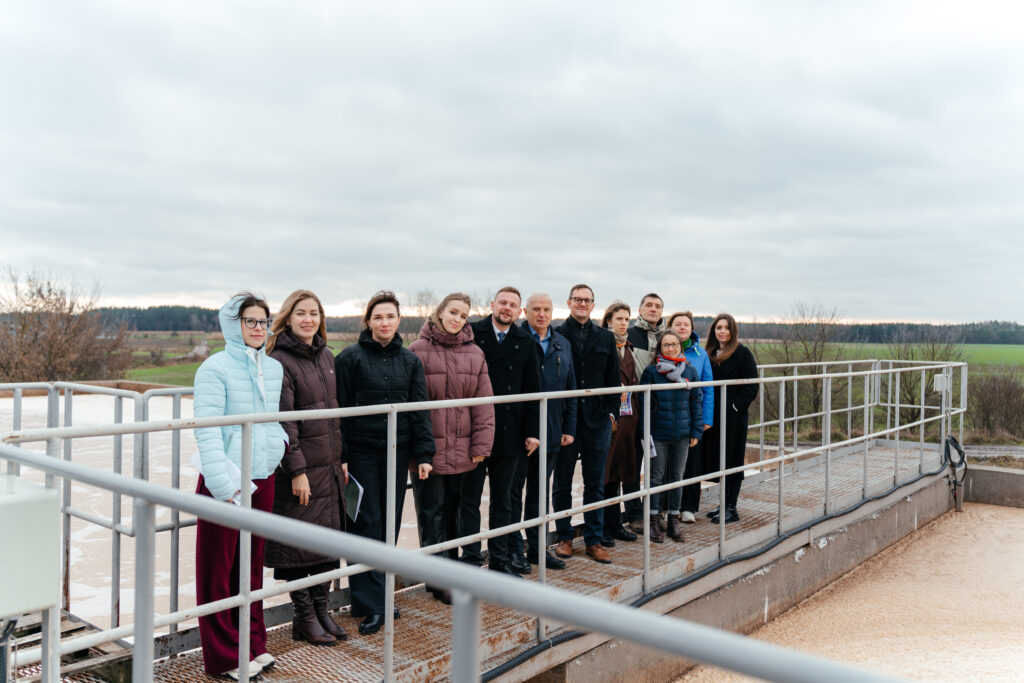
LLC “Radyvylivmoloko” — one of the largest dairy producers in Western Ukraine, has completed a major environmental modernization. The company has built a complex of treatment facilities for industrial wastewater with a capacity of 500 m³ per day. The project was implemented with the support of the programme Best Available Techniques (BAT) for Ukraine
From a separator point to a modern factory
The enterprise, located in the village of Krupets, Dubno district, Rivne region, has come a long way in its development. Since 1976, a separator point operated here as part of the Dubno cheese factory. Everything changed in 1996, when the current director took over the leadership of the company.
I came as a director in ’96. At that time the enterprise was processing 3 tonnes of milk per day, and 30 people worked here. When I arrived, I understood that the separator point was not the future. So I had to start building a factory, says Anatoliy Hrysyuk, Director of LLC “Radyvylivmoloko”.
Over 30 years, the enterprise has transformed into a modern dairy plant. Today more than 800 people work here, including employees who are involved in collecting milk, processing it, and selling products. Every year the factory pays more than 125 million hryvnias in taxes. The enterprise produces fermented dairy products, hard and semi-hard cheeses, butter, and casein under the trade marks “RadyMo”, Farm Fresh, and “Milkove”. Part of the production butter, casein, and several types of cheese is exported.
With the growth of production, the amount of wastewater also increased up to 340 m³ per day. Dairy processing waste was traditionally transported by tractor and disposed of in filtration fields. This approach did not meet modern standards for handling industrial wastewater, especially since the factory is located directly within the boundaries of a residential area.
With the development of the enterprise, I understood that without building treatment facilities there would be no future. This is both a matter of ecology and a matter of relations with local residents, because the factory is located within the village, the director explains.
In order to find the best solution, the director spent time studying the experience of wastewater treatment in Europe and visiting enterprises where modern treatment systems operate. “I did not find a good example in Ukraine”, he states. Therefore, a decision was made to build with the involvement of a European company and using European equipment.
LLC “Radyvylivmoloko” received grant support from Deutsche Gesellschaft für Internationale Zusammenarbeit (GIZ) GmbH within the framework of Best Available Techniques (BAT) for Ukraine
The program is implemented on behalf of the International Climate Initiative (IKI) of the Federal Ministry for the Environment, Nature Conservation, Nuclear Safety and Consumer Protection of Germany. The grant covered up to 20% of the construction costs of the treatment facilities. A loan was provided by JSC Oschadbank.
Having learned that there was an opportunity to participate in the grant, we wrote a proposal and won the grant. The part of the funds we received from GIZ helped us to put the treatment facilities into operation more quickly and efficiently, says the director.
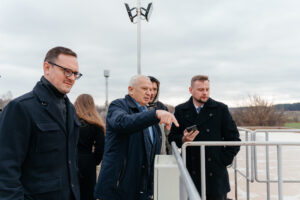
The enterprise was selected on a competitive basis on a number of key criteria. An important role played the high environmental significance of the project for the region and the potential for scaling up in the dairy processing industry.
What was built: European-level technologies
Within the project, a complex of industrial wastewater treatment facilities with a capacity of 500 m³/day was constructed and put into operation. The system includes buffer, anoxic, aeration, and selector tanks, adapted to the specific features of dairy processing production.
A system of partial recirculation of treated water for technological needs was also introduced in particular for washing containers and equipment. The operation of the complex is supported by an automated system for monitoring treatment parameters and the environment in real time. “The new treatment facilities are built using modern technology. Everything happens in automatic mode,” the factory director emphasizes.
What changed after the treatment facilities were launched
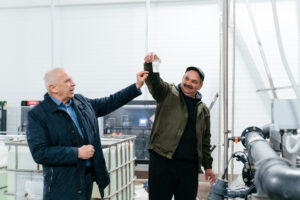
According to the technical specialists of the enterprise, within the framework of the project implementation, wastewater treatment efficiency of nearly 100% was achieved. In addition, 1/3 of the treated water is now reused for technical needs — maintaining fire reservoirs, cleaning the territory, and so on. Independent laboratories confirmed the effectiveness of the system’s operation. The treated water, which meets environmental standards, is discharged into the river.
Consumption of fresh water also decreased by more than 20, the load on the treatment facilities was reduced, and costs for water disposal went down. The enterprise has been brought into compliance with the requirements of Directive 2010/75/EU on industrial emissions.
“For me, this grant is an environmental result, it is a result for the future. It is the preservation of nature, the health of people, and the peace of the community,” the head of the enterprise summarize.
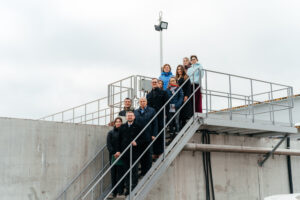
The issue of wastewater previously caused dissatisfaction among residents of the surrounding villages. After the treatment facilities were put into operation, these complains stopped. Employees of the enterprise point out that from the very beginning the project had a social focus.
First of all, this is a socially oriented project. We are located within the boundaries of villages, so that there are no unpleasant smells, so that there are no public disturbances.
The positive effect is also noted at GIZ. Gabriel Sauer, Director of the Project “Best Available Techniques for Ukraine”, particularly emphasizes the social dimension of the implemented project:
I think it is worth highlighting that there is a very significant change for the population here, which has substantially improved over the past year thanks to the implementation of these technologies. The surrounding communities sometimes complained about the wastewater produced at this enterprise, and now this problem no longer exists. I think this is a real relief for the entire surrounding community and for the farmers, Mr. Sauer comments.
Experience worth scaling up
Specialists of the enterprise are convinced: similar solutions should become the standard for the industry.
Such things must exist in Ukraine. They must be present at every enterprise. People need to be given the opportunity to learn, so that they implement and use the best technologies.
The factory director is already looking further ahead: if the enterprise continues to grow, the next step may be the construction of additional treatment facilities using biogas, which would make it possible to turn waste into a source of energy.