How can European and national climate adaptation goals be translated into concrete action on the ground? And how can communities better prepare for climate risks — from extreme heat and droughts to water scarcity and flooding?
These questions were discussed at the panel “Governing Climate Adaptation Across Levels: From European Policy to National and Local Action”, held on 12 November at COP31 in Antalya. The event was organised by the Institute for Economics and Forecasting of the National Academy of Sciences of Ukraine.
Daniela Goehler, Head of the Ukrainian Climate Office and Director of the project “Support for Ukraine in Implementing the Paris Agreement (PAABS)”, took part in the discussion. She presented the project’s approach to supporting climate change adaptation in Ukraine, with a focus on the water sector and Odesa Oblast as a pilot region.
How does PAABS support climate change adaptation in practice?
- It bridges local and national action. The project promotes coordination between government institutions, regions and communities. This helps translate national adaptation goals and European approaches into practical solutions, while ensuring that communities’ needs and experience inform national policymaking.
- It turns climate risk assessments into a basis for planning. This year, PAABS completed a gender-responsive climate risk and vulnerability assessment for Odesa Oblast. The main risks identified include extreme heat, droughts, water scarcity, heavy precipitation and localised flooding. The findings will inform the development of a regional adaptation strategy and adaptation plans for three communities.
- It helps communities move from planning to implementation. PAABS provides practical knowledge, planning tools and technical support to help communities not only identify climate risks but also develop concrete project proposals, including cost estimates and clearly defined financing needs.
- It supports practical solutions in the water sector. Potential measures include improving the resilience of water supply to droughts, restoring ecosystems and implementing nature-based solutions to retain water and reduce flood risks. Since water resources are often shared by several communities, cooperation at river basin level is also essential.
Effective climate change adaptation requires coordinated action at all levels — from national policymaking to local initiatives. This is particularly important for Ukraine’s recovery, as climate risks directly affect community safety, water availability and regional development.
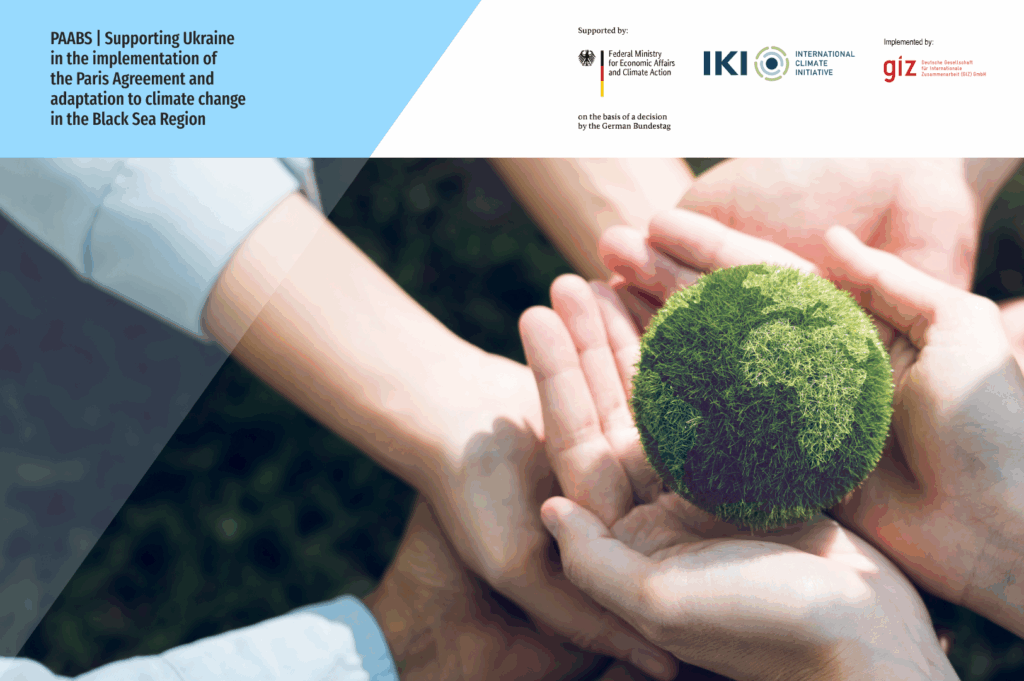
PAABS is funded by the Federal Ministry for the Environment, Climate Action, Nature Conservation and Nuclear Safety (BMUKN) under the International Climate Initiative (IKI), the project is supported and coordinated by Deutsche Gesellschaft für Internationale Zusammenarbeit (GIZ) GmbH. PAABS stands for “Support to Ukraine in the Implementation of the Paris Agreement and Adaptation to Climate Change Impacts in the Black Sea Region”.