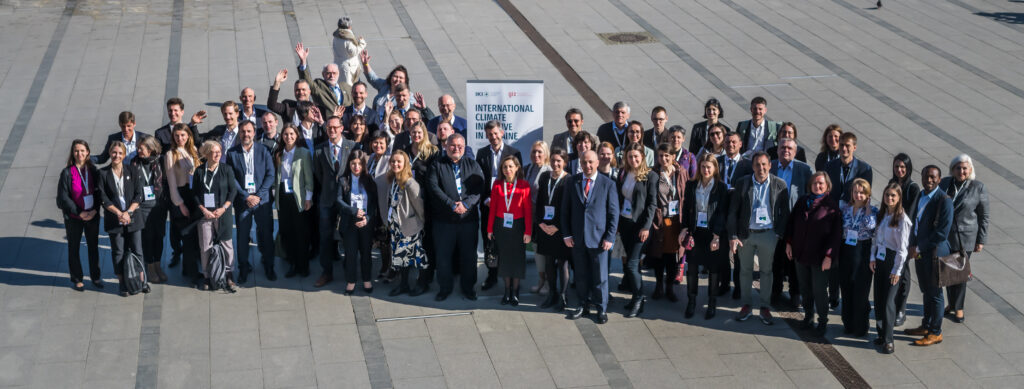
On 13 November 2026, the panel discussion “From Commitment to Action: Aligning NDC Implementation with Climate Finance in Ukraine, Türkiye, Albania and Moldova”, organised by the IKI Interface Ukraine project (GIZ), took place at the Ukrainian Pavilion at COP31.
Participants explored how to translate Nationally Determined Contributions (NDCs) into concrete investment projects, which financial instruments can support their implementation, and what conditions are needed to mobilise public and private capital. Particular attention was given to the challenges facing Ukraine, which must pursue its climate commitments while recovering from Russia’s full-scale war.
Ukraine: Assessing Financing Needs and Market Opportunities
The Ukrainian perspective was presented by Yevhenii Moroz from the Ministry of Economy and Environment of Ukraine, alongside Roman Podoliets and Yevhen Bublik from the Institute for Economics and Forecasting of the National Academy of Sciences of Ukraine.
During their presentations, the speakers discussed the development of a financing strategy for implementing Ukraine’s second Nationally Determined Contribution (NDC 2). The strategy involves a comprehensive assessment of Ukraine’s financial market, existing support programmes and instruments, barriers to mobilising investment, and sector-specific financing needs.
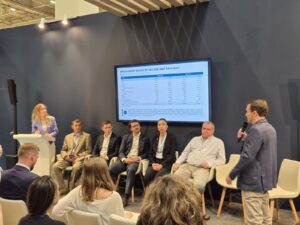
According to an assessment prepared by experts from the Institute for Economics and Forecasting of the National Academy of Sciences of Ukraine within the IKI Interface Ukraine project (GIZ), Ukraine will need approximately EUR 130 billion in investment to achieve its climate targets by 2035 under the current measures scenario. Implementing additional measures would require a further EUR 66 billion in financing.
To assess the opportunities offered by the financial market, an analytical database covering 99 financial instruments and programmes has been developed. It includes direct investment, incentive mechanisms and technical assistance instruments designed to strengthen the private sector’s capacity to access affordable financing.
Ukrainian representatives also outlined key areas of climate policy development, including the update of the National Energy and Climate Plan (NECP), preparations for introducing a greenhouse gas emissions trading system in line with EU standards, the development of mechanisms under Article 6 of the Paris Agreement, and the establishment of a legislative framework for a green taxonomy.
These efforts are intended to integrate climate objectives into recovery plans, public investment decisions and Ukraine’s long-term economic development strategies. At the same time, the full-scale war creates considerable uncertainty for long-term planning, making measures essential to the country’s economic resilience and recovery an immediate priority.
Türkiye: From Economic Modelling to Industrial Decarbonisation
Türkiye’s experience was presented by Meral Mungan Arda, Climate and Environment Portfolio Manager at UNDP Türkiye, who spoke about support for the preparation and implementation of the country’s Nationally Determined Contributions.
In preparing its third Nationally Determined Contribution (NDC 3.0), Türkiye applied economic modelling and strengthened the capacity of relevant government institutions. This laid the groundwork for further climate planning and the implementation of climate measures.
Key priorities for implementing NDC 3.0 include deep decarbonisation of industry, particularly fertiliser production, through the use of hydrogen technologies and carbon capture and utilisation solutions. Another priority is reducing emissions from the waste management sector by introducing modern practices and Zero Waste approaches.
The discussion also highlighted the importance of international technical assistance in getting innovative pilot projects off the ground. These projects are expected to serve as models that can subsequently be scaled up with support from national financial institutions and private investors.
Albania: Integrating Climate Objectives into Public Policy and Investment
Joel Skënderaj from Albania’s Ministry of Environment presented the country’s experience in implementing its climate commitments following the adoption of NDC 3.0. Albania is now focusing on translating its climate targets into action while aligning its climate policy with the EU accession process.
The country’s main priorities include accelerating the energy transition through the development of renewable energy, improving energy efficiency and introducing sustainable transport solutions. Climate change adaptation is another important area, particularly in addressing the risks of wildfires and floods, which affect agriculture, water resources and local communities.
Achieving these objectives requires climate priorities to be integrated into sectoral strategies, public investment processes and medium-term budget planning.
Key challenges include limited institutional and technical capacity at both central and regional levels, as well as the need for robust cost-benefit analyses, feasibility studies and clear financing mechanisms. Building a pipeline of investment-ready projects with measurable results also remains an important task.
Moldova: EU Integration as a Driver of Climate Investment
Moldova’s experience was presented by Inga Podoroghin from GIZ Moldova. She noted that over the past five years, the country has made significant progress in its green transition and climate policy. The EU accession process has been a major driver of these changes, accelerating reforms across various sectors and supporting the alignment of national legislation with European standards and climate objectives.

According to Inga Podoroghin, more than USD 2 billion has been invested in Moldova’s agriculture, waste management, water supply, transport and energy sectors over the past five years. These investments directly support the country’s efforts to reduce emissions, adapt to climate change and meet its Nationally Determined Contribution (NDC) commitments.
Moldova is gradually integrating climate objectives into public investment planning and financing processes. The NDC and the National Energy and Climate Plan provide strategic direction for climate policy and help ensure that climate priorities are reflected in investment decisions.
One example highlighted by the speaker was the Reform and Growth Facility for Moldova, funded by the EU. At least 37% of investment projects under this facility must contribute to climate objectives. In the municipal solid waste management sector, investments mobilised from European international financial institutions include measures to reduce methane emissions from landfills, alongside monitoring systems to track emission reductions.
Inga Podoroghin also highlighted developments in the energy sector. A clear strategic and regulatory framework has helped attract significant investment in energy efficiency, renewable energy and electricity grid modernisation. At the same time, Moldova is developing its own financial mechanisms, including the EcoVoucher programme, which supports households in replacing old appliances with energy-efficient alternatives, and the Green Home programme, which aims to improve the energy efficiency of residential buildings.
From Climate Plans to Investment: The Role of Coordination and Partnerships
Joaquim Leite, a representative of the NDC Partnership, focused on how countries can turn climate plans into concrete investment decisions.
He emphasised the importance of embedding climate objectives in a country’s broader economic development strategy. NDC implementation should not be treated as a standalone process: climate priorities need to be reflected in economic decision-making, public budget planning and investment strategies.
This requires close cooperation between ministries of economy and finance, sectoral ministries, central banks and other institutions that influence the allocation of public resources and the mobilisation of private capital.
The discussion also highlighted the importance of engaging potential investors and international financial institutions at an early stage in the development of climate plans and investment programmes. This allows countries to assess risks in advance, identify necessary regulatory changes and tailor projects to the requirements of different financing sources.
International knowledge exchange is another important factor. Cooperation between countries facing similar economic conditions and challenges helps identify practical solutions, draw lessons from successful approaches and adapt them to national contexts.
From Plans to Tangible Results
The discussion demonstrated that successful NDC implementation depends not only on the ambition of climate targets but also on the ability to translate them into concrete investment decisions. This requires clear financing strategies, coherent public policies, well-prepared projects and effective cooperation between governments, businesses and international partners.
For Ukraine, this is particularly important. Climate action must become an integral part of the country’s green recovery, the modernisation of its industry and energy sector, and its European integration.
The event was organised by the project “IKI Interface: Supporting Ukraine towards Ambitious and Integrated Climate Policy (Green Ukraine)”. The project is implemented by Deutsche Gesellschaft für Internationale Zusammenarbeit (GIZ) GmbH on behalf of the Federal Ministry for the Environment, Climate Action, Nature Conservation and Nuclear Safety (BMUKN) under the International Climate Initiative (IKI), in cooperation with the Ministry of Economy, Environment and Agriculture of Ukraine.