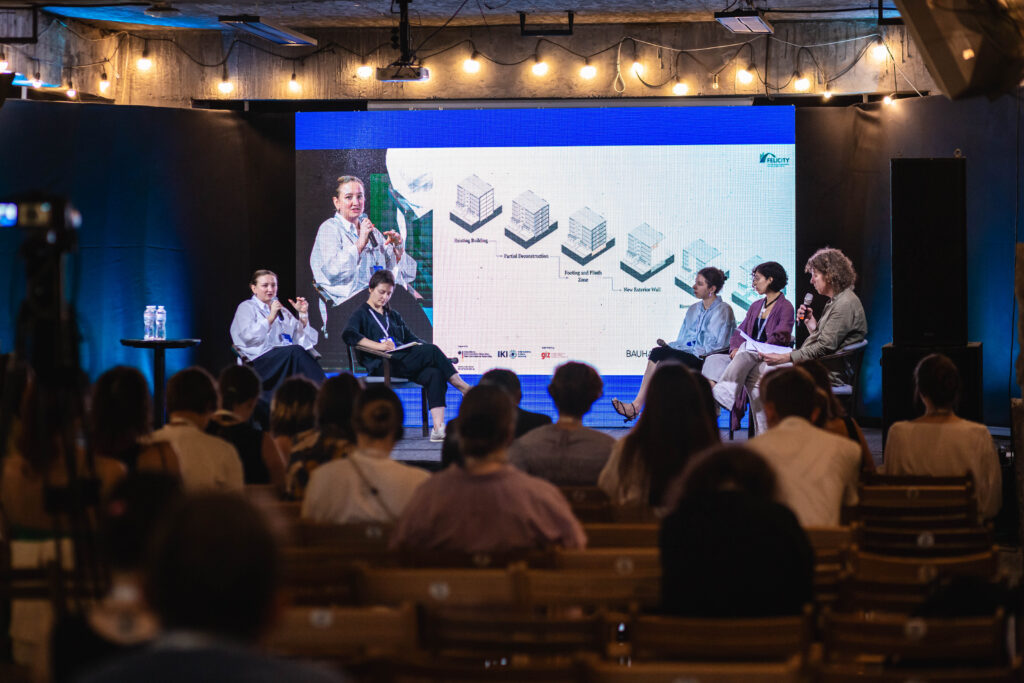
Can Ukraine’s reconstruction become a catalyst for developing a circular building sector? This question was at the centre of the panel discussion “How to Support the Circular Building Sector?” held during the Lviv Urban Forum on the 2d of July.
The discussion drew on the findings of the study “Embodied Carbon – A Material Compass for the Reconstruction of War-Damaged Residential Buildings in Ukraine in Alignment with EU Standards”, prepared by Bauhaus Earth in cooperation with Ro3kvit with the support of the FELICITY II programme. Bringing together experts from Ukraine and Germany, the session explored how circular construction principles can contribute to climate-smart reconstruction and support Ukraine’s long-term recovery.
Participants discussed three key areas. The first focused on how the reuse of construction materials, bio-based materials, and circular design approaches can support not only the reconstruction of buildings, but also the recovery of communities. The second examined how stronger cooperation between architects, manufacturers, construction companies, municipalities, and residents can help make circular solutions technically feasible and economically viable. The third explored how energy efficiency and circularity can be combined to reduce greenhouse gas emissions, lower lifecycle costs, and improve the quality of housing.
A key conclusion of the discussion was that circular construction extends far beyond the choice of building materials. It requires a new approach to planning, resource management, and collaboration across the entire construction value chain. Integrating these principles into Ukraine’s reconstruction can support the country’s climate objectives and alignment with European standards.
The discussion forms part of FELICITY II’s broader efforts to promote climate-smart reconstruction by translating research into practical recommendations for municipalities, policymakers, and practitioners involved in Ukraine’s recovery.
Read the full study.
The FELICITY II – Embodied Carbon project is implemented by Bauhaus Earth and Ro3kvit within the framework of the International Climate Initiative’s (IKI) Eastern Partnership and Central Asia Programme (FELICITY II). FELICITY II is implemented by Deutsche Gesellschaft für Internationale Zusammenarbeit (GIZ) GmbH in cooperation with the European Investment Bank and supported by the German Federal Ministry for the Environment, Climate Action, Nature Conservation and Nuclear Safety under IKI.