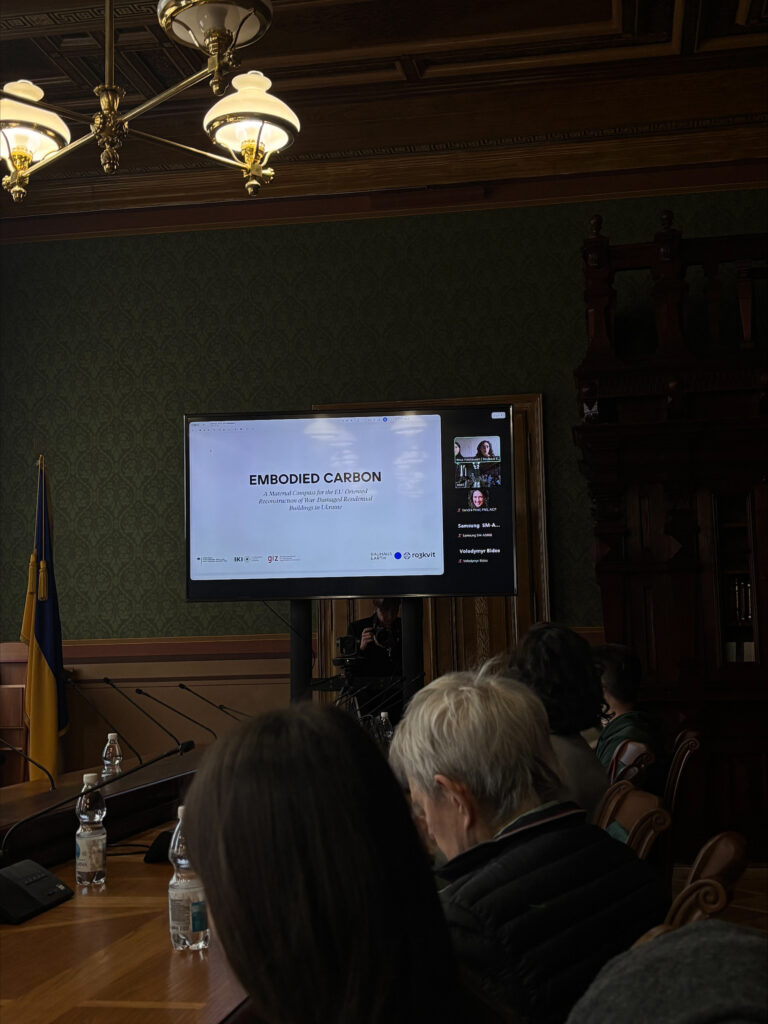
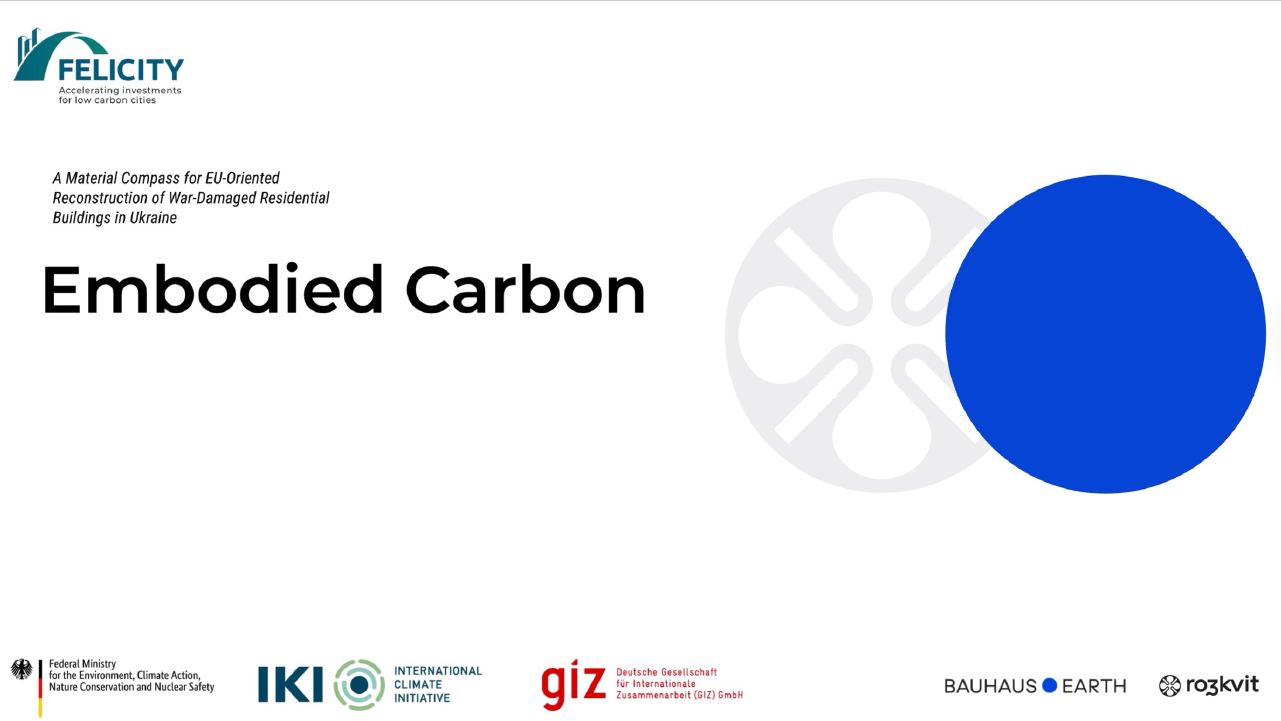
On 20 March 2026, during the conference Safe, Sustainable and Swift Reconstruction of Ukraine in Lviv, the research team of Bauhaus Earth presented the key findings of the study “Embodied Carbon – A Material Compass for the Reconstruction of War-Damaged Residential Buildings in Ukraine in Alignment with EU Standards.”
Developed with the support of the FELICITY II programme in cooperation with Ro3kvit, the study explores how the principles of the New European Bauhaus can be translated into practical solutions for the reconstruction of Ukraine’s housing sector. As Ukraine faces the challenge of rebuilding thousands of damaged residential buildings, decisions on construction materials will have long-term implications for greenhouse gas emissions, resource consumption, and climate resilience.
The study provides practical guidance on selecting materials with lower embodied carbon. It promotes approaches that support circular construction, reduce emissions across the building lifecycle, and align reconstruction efforts with European standards and Ukraine’s climate commitments.
By linking research with practical implementation, the study helps ensure that reconstruction efforts not only restore housing but also contribute to a more sustainable and climate-resilient built environment.
Read the study:
FELICITY II is an international initiative supporting sustainable urban infrastructure development in Eastern European and Central Asia countries, aiming to reduce greenhouse gas emissions. The programme provides technical and analytical assistance to municipalities to help them design and implement climate-friendly investments in water supply, wastewater management, and energy-efficient buildings.
FELICITY II is implemented by Deutsche Gesellschaft für Internationale Zusammenarbeit (GIZ) GmbH in cooperation with the European Investment Bank and with the support of the German Federal Government, under the framework of the International Climate Initiative (IKI).