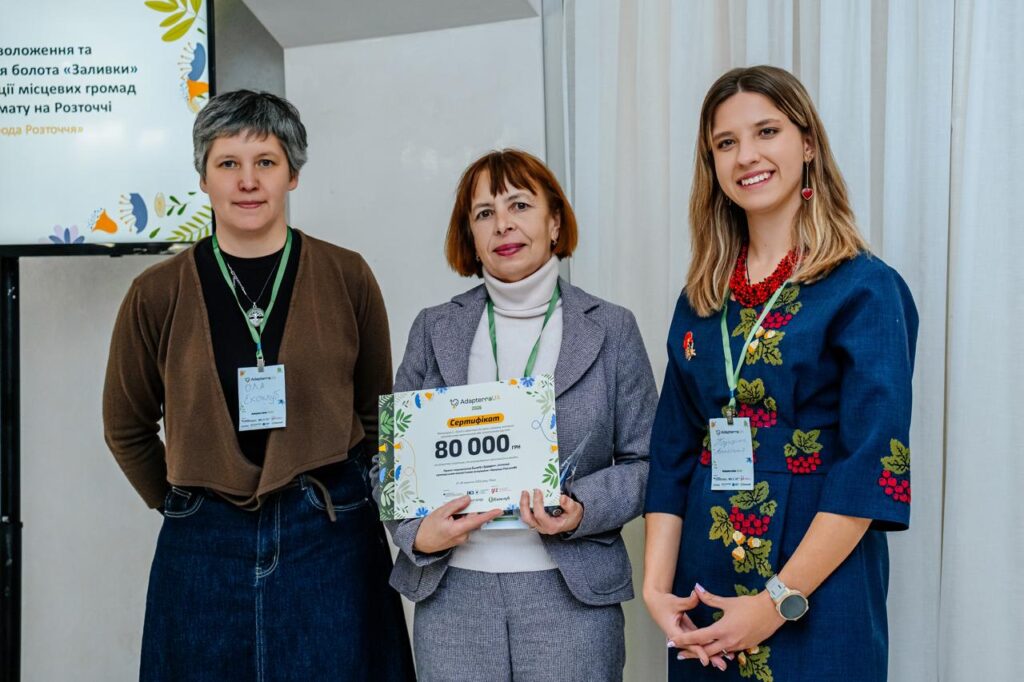
On 27 October in Rivne, Ecoclub announced the winners of the competition for the best solutions by Ukrainian communities for adapting to climate change. Out of 51 applications, more than 2,500 people voted openly to choose three winners:
Bilohorshcha Peatland, Lviv. Peat used to be extracted here, and now the bog is getting its water regime and vegetation back to stop underground fires and restore the natural state of the area. Already this summer, thanks to the work done and despite the drought, the peatland did not catch fire, unlike the neighboring one, where fires break out every summer. Bilohorshcha lies within the city limits and is an excellent place to observe birds, plants and animals. The restoration project is implemented by the Department of Ecology and Natural Resources of the Lviv City Council.

Zalyvky Bog, Roztochchia (Lviv Oblast). This wetland was also drained at some point for peat extraction, and fires broke out here too, harming both nature and local residents. In 2016, ecologists launched a project to bring water back to Zalyvky. The same canals that once drained the bog now retain water. Machinery is not allowed in the nature reserve, so the oak dams were built by hand. Today the fires have stopped, and plants that grow only on moist soils are returning to the bog. Residents who initially opposed the creation of the reserve on these lands because of restrictions on economic activity (for example, a ban on mowing grass and gathering cranberries) felt the benefits of the bog’s restoration immediately and now support the effort. The project is implemented by the public environmental association “Pryroda Roztochchia.”

The guide “Trees of the Future for Central Ukraine,” Poltava. Specialists in Poltava compiled a guide to tree species that will withstand heat and drought several decades from now. According to the authors, a tree is a long experiment: planted today, it has to grow in a climate that does not yet exist. The tree species of the future recommended by the authors include plane trees, European lindens, red horse-chestnuts, Japanese pagoda trees and others. The guide’s recommendations will be useful for the climate conditions of cities in Central Ukraine. It was developed by Anna Martynova and Kyrylo Martynov, together with Maksym Makukha, head of the municipal enterprise “Dekoratyvni Kultury” in Poltava.
Each winner will receive UAH 80,000 to develop their initiative.
Special awards were also presented at the event. The project “Regenerative Viticulture in the Black Sea Region: Climate Change Adaptation through Soil Restoration, Biodiversity and Nature-Based Solutions” was recognized by the General Staff of the Armed Forces of Ukraine, represented by Yurii Trachuk, Senior Officer of the Central Directorate for Civil-Military Cooperation. The project was honored for its contribution to restoring the environment after war damage: vineyards are being planted on demined lands in the Mykolaiv oblast. Heorhii Molchanov and local winegrowers are applying the principles of regenerative farming on demined plots, restoring ecosystems and growing technical grape varieties.

The competition organizers presented another special award to Svitlana Krakovska, climatologist, meteorologist and key expert in applied climatology at Egis Ukraine LLC, for the white paper “Climate Change Adaptation at the Regional Level: Innovative Approaches in Ukraine.” The paper presents a unified methodology for regional climate change adaptation strategies in three pilot oblasts: Lviv, Ivano-Frankivsk and Mykolaiv. It can be scaled up to other oblasts, to the whole country and to the city level. It takes into account more than 30 parameters of temperature, wind and moisture, assesses the vulnerability of different economic sectors through to the end of the century, and includes a list of the necessary adaptation measures. For example, the publication provides for 168 measures costing EUR 273.7 million for the Lviv oblast, 171 measures costing EUR 155.7 million for the Mykolaiv oblast, and 158 measures costing EUR 152.65 million for the Ivano-Frankivsk oblast.
All the solutions mentioned can be used by other communities. The projects of the winners and finalists are collected on the website https://adapterra.org.ua/. Not all solutions require significant financial investment. Sometimes it is enough for community residents to rethink their usual approaches to caring for natural areas and urban spaces.
The competition was also held with the support of the Czech Environmental Partnership Foundation (Nadace Partnerství) and the Ukrainian Climate Network, contributing to the promotion of climate change adaptation in Ukraine.